
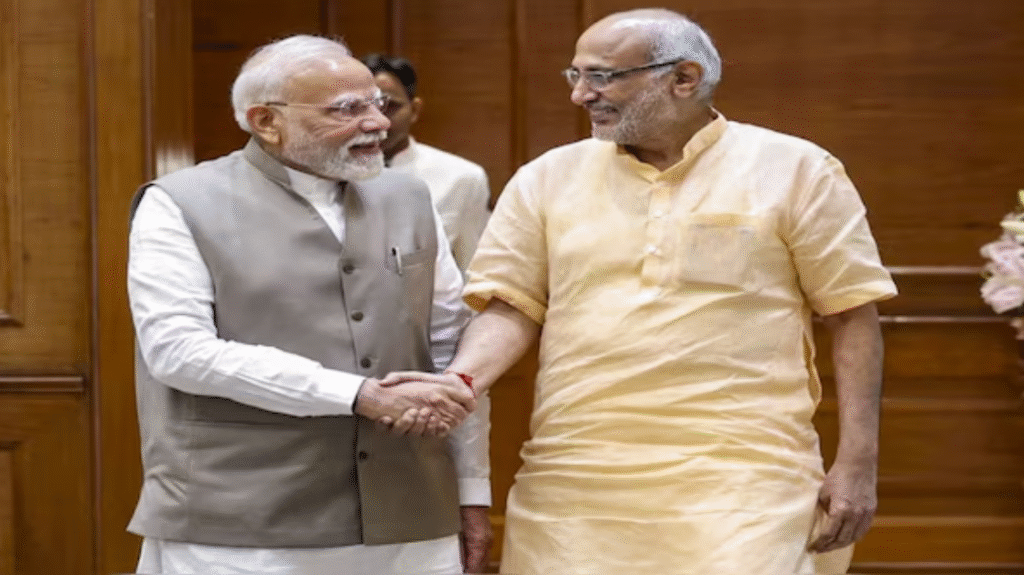
Radhakrishnan Clinches Vice President Post Amid Political Drama
In a high-stakes constitutional contest, CP Radhakrishnan, the NDA’s nominee and Governor of Maharashtra, was elected 15th Vice President of India on September 9, 2025. He secured 452 first-preference votes out of 752 valid ballots, defeating the INDIA bloc’s joint candidate, Justice B. Sudershan Reddy, who garnered 300 votes, while 15 ballots were invalid.
Electoral Process: Numbers and Voting Dynamics
Parliamentary Voting Mechanism
The Vice President is elected by a secret ballot of Members of Parliament from both houses, using the single transferable vote system. As Rajya Sabha Chair, the VP may also serve as Acting President when necessary.
Vote Breakdown & Cross-Voting
Out of 767 votes cast, 752 were valid and 15 invalid. Despite NDA’s expected votes totaling 438, Radhakrishnan exceeded this figure by 14, hinting at cross-voting from Opposition MPs.
Turnout & Speedy Results
Polling saw a strong 96% turnout, and the results were declared within an hour of counting, underscoring procedural efficiency.
Opposition Response: A Moral Loss Amid Defeat
Despite the numerical loss, Opposition leaders framed the outcome as a “moral and ideological setback” for the NDA. Congress’s Jairam Ramesh noted that the INDIA bloc secured 40% of the vote, an improvement from 26% in the last election.
Justice Reddy echoed this sentiment, asserting that while the election is over, the ideological battle continues with vigour.
Who Is CP Radhakrishnan?
- A seasoned politician, Radhakrishnan has served as Coimbatore MP, BJP Tamil Nadu President, and Governor of Jharkhand and Maharashtra.
- Member of the Rashtriya Swayamsevak Sangh (RSS), he is viewed as calm and consensus-oriented.
Legal Significance & Constitutional Context
Role of the Vice President
As India’s second-highest constitutional position, the VP chairs the Rajya Sabha and stands in as Acting President if needed. Although largely ceremonial, the role is key to legislative continuity and constitutional order.
Election Integrity
The post has no party whip, giving MPs full autonomy in voting, strengthening the democratic ethos of the process.
Cross-Voting Implications
Cross-voting and invalid ballots indicate shifting political loyalties and internal party tensions, especially among Opposition MPs.
Historical Echoes and Political Undertones
Similar Vice Presidential races often combine politics, ideology, and constitutional symbolism. Human rights demands and democratic values frequently are highlighted. Radhakrishnan becomes the third Tamil Nadu-born Vice President, marking regional representation in high office.
What Happens Next?
- Swearing-In Ceremony – Formal induction of Radhakrishnan expected soon, marking a new constitutional term.
- Opposition Strategy – Despite ideological rhetoric, INDIA bloc must regroup ahead of key state elections.
- Legislation & Governance – The new VP’s role in Rajya Sabha may be critical during constitutional debates and legislative sessions.
Conclusion
The Vice President Election 2025 was more than a ceremonial contest. CP Radhakrishnan’s win reflects the NDA’s dominance, but the Opposition’s strong showing signals persistent political resilience. With procedural fairness and spirited ideological contest, the election reinforced the democratic spirit that underpins India’s institutional landscape.
To read more Indian Laws and news, visit Legal Guide India

Pingback: High-Stakes Vice President Election 2025: Radhakrishnan vs Reddy in Focus - Legal Guide India